

At 6:35 PM Eastern on April 1, 2026, the Space Launch System rocket lifted off from Launch Complex 39B at Kennedy Space Center in Florida — the same pad that sent Apollo and Space Shuttle missions into orbit. The four-person crew of Orion, named Integrity, became the first humans to travel beyond low Earth orbit since the Apollo 17 crew splashed down in December 1972.
This is not a moon landing. Artemis II is a test flight — a 10-day arc that will take the crew around the Moon on a free-return trajectory and bring them back to splash down in the Pacific Ocean off San Diego on April 10. The goal is to verify that every system on Orion works with humans aboard: life support, propulsion, power, thermal management, navigation, and communications — in the deep space environment that kills spacecraft in ways a low Earth orbit simulation simply cannot replicate.
On April 6, the crew surpassed the previous distance record set by the Apollo 13 crew in 1970 — 248,655 miles from Earth — reaching a maximum of 252,760 miles. That record was set in tragedy: Apollo 13 drifted to that distance because an oxygen tank explosion forced the crew to loop around the Moon on a free-return trajectory to survive. Artemis II reached that distance on purpose, under power, with all systems nominal.
Commander Reid Wiseman, on seeing Earth from deep space: "There was a moment about an hour ago where Mission Control reoriented our spacecraft as the sun was setting behind the Earth. And I don't know what we all expected to see, but you could see the entire globe, from pole to pole. You could see Africa, Europe, and if you looked really close, you could see the northern lights."
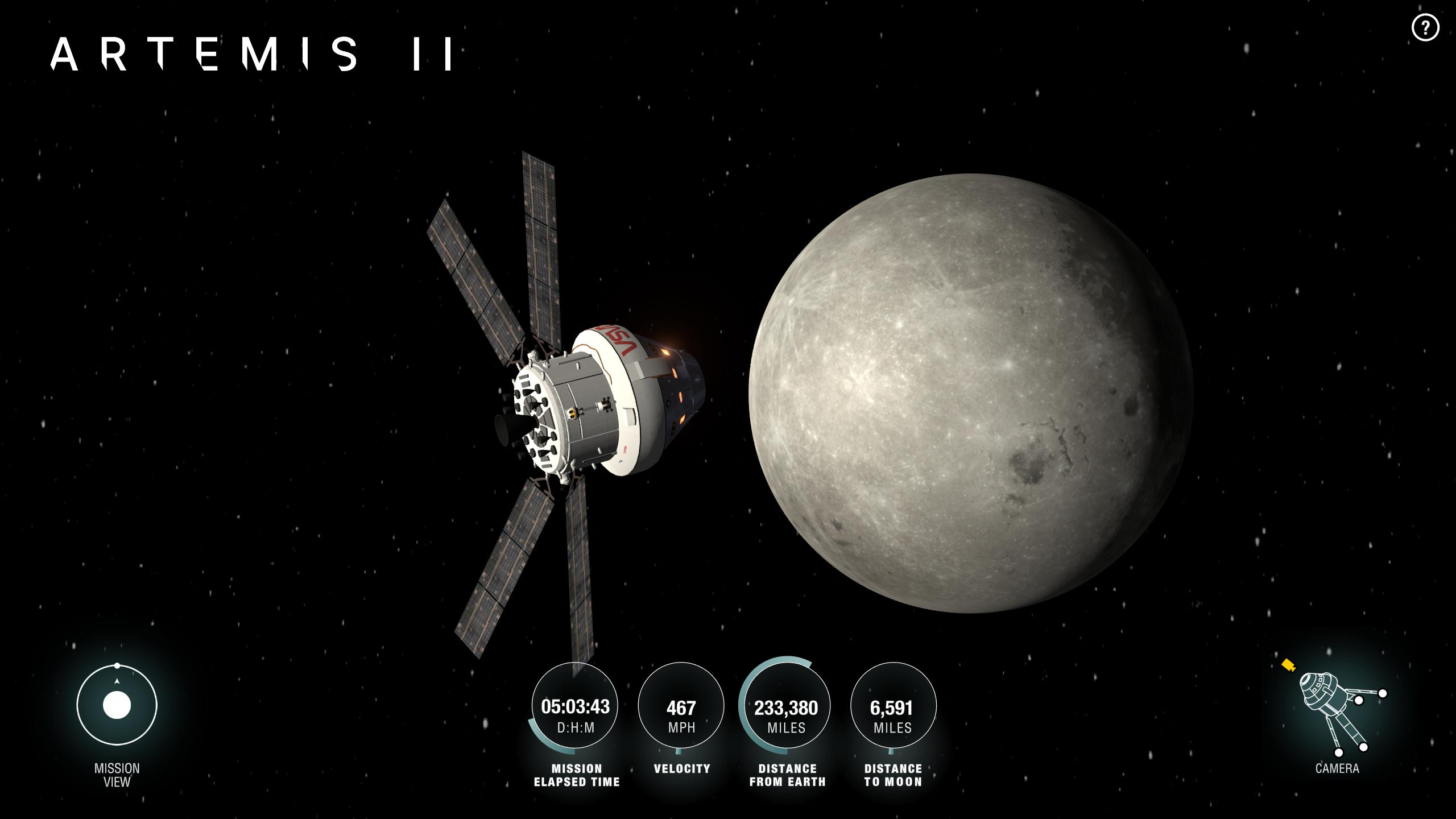


NASA does not provide a standalone cost figure for Artemis II. What we have are confirmed government audits, Inspector General reports, and independent analyses. These are the numbers on the record.
| Item | Cost | Source |
|---|---|---|
| Operating cost per Artemis launch (SLS + Orion) | $4.1 billion | NASA Office of Inspector General, 2021 audit |
| Cumulative SLS + Orion + ground systems by launch | $55B+ | NASA OIG follow-up audit, 2024 |
| Total Artemis program estimate through 2025 | ~$93 billion | NASA OIG estimate, cited by Bloomberg |
| NASA FY2026 budget (Congress approved) | $24.4 billion | Congressional appropriations, 2026 — rejected 24% White House cut |
| SLS program overrun vs. original 2011 budget | 140% over | White House FY2026 budget proposal — even called it "grossly expensive" |
| European Service Module (Orion's power/propulsion) | ESA contribution | Signed 2013 — saved NASA billions vs. building it themselves |
| Cost per astronaut per lunar flyby mission (4 crew, $4.1B launch) | ~$1.025 billion | NASA OIG / derived figure |
Apollo 8 — the first crewed mission to the Moon — completed a comparable lunar flyby in 1968 as part of a program that cost roughly $25 billion in 1970s dollars. Accounting for inflation, that's about $200 billion today for the entire Apollo program, which landed on the Moon six times. Artemis has spent $93 billion and hasn't landed yet.
The key difference: the SLS rocket is expendable. It uses the same solid rocket boosters as the Space Shuttle but throws them away after each launch. SpaceX's Starship — which NASA is also paying to develop as the Artemis lunar lander — is fully reusable. The structural reason the SLS costs $4.1 billion per flight is a political one: Congress mandated the use of existing Shuttle-derived hardware in the 2010 Authorization Act, protecting aerospace jobs in key states. The Trump administration's own FY2026 budget called for terminating SLS after Artemis III. Congress overruled it.
None of this diminishes what Artemis II accomplished. It does mean the infrastructure being built could have been built cheaper, and that question deserves honest acknowledgment alongside the achievement.
Artemis II is a test flight. That sounds modest. It isn't. The systems being validated on this mission — life support, deep-space navigation, thermal protection during lunar reentry, communications across 252,000 miles — are the same systems that will keep people alive on Artemis III when they try to land on the Moon's south pole. A failure in any of them that goes undetected now could kill astronauts later. The unglamorous, expensive test flight is the thing that makes the landing survivable.
Three milestones in this mission have no precedent in living memory. Victor Glover is the first person of color to travel beyond low Earth orbit. Christina Koch is the first woman to do so. Jeremy Hansen is the first Canadian. These are not symbolic achievements alongside the technical ones — they are the technical ones. The mission required the most capable crew available. These were those people.
The distance record is also worth sitting with. The previous record holder — the Apollo 13 crew — reached 248,655 miles because their spacecraft was dying and they were trying not to die with it. Artemis II reached 252,760 miles on purpose, under control, with the crew taking turns looking out the window at the Moon. That is the difference a half-century of work makes.
"There was a moment where Mission Control reoriented our spacecraft as the sun was setting behind the Earth. You could see the entire globe, from pole to pole. Africa, Europe, and the northern lights. Knowing we're about to get similar views of the Moon — I'm just, I'm really excited for that."
— Christina Koch, Artemis II Mission Specialist · En route to the Moon · April 4, 2026


Artemis III aims to land two astronauts on the Moon's south pole — potentially in 2028. The lander will be SpaceX's Starship, Human Landing System variant. The south pole was chosen because of confirmed water ice in permanently shadowed craters — a potential resource for long-duration exploration and eventual Mars missions.
The Lunar Gateway — a planned space station in lunar orbit — was cancelled in March 2026. The program will proceed without it for the near term. The SLS program itself faces ongoing political pressure: the Trump administration proposed terminating it after Artemis III in favor of commercial systems. Congress has so far protected it.
If Artemis II succeeds — if the heat shield, the life support, the navigation all hold up — humans will stand on the Moon again within the decade. That outcome is not guaranteed. But April 1, 2026 is the day we got back on the road to it.
Independent. No ads. No paywalls. All sourced.
No corporate funding. No ads. Crypto donations keep this running.